Why Legging Pockets Bounce When You Run (And the Fix Nobody Talks About)
Quick Answer: Legging pockets bounce during running because most are placed on the outer thigh — a point that swings through the widest arc of motion in your running stride — and rely on the surrounding stretch fabric alone to hold the phone’s weight, with no reinforced opening or interior seam to stabilize it. The fix is a pocket built with a stabilizing interior seam or reinforced binding at the opening, positioned closer to the hip where stride motion is smaller, sized close to the phone’s actual dimensions rather than deliberately oversized.
You’ve tried tightening the waistband, tying the laces double, running with your phone in your hand instead — anything to stop that rhythmic thigh-slap every stride. It’s not you overthinking it. Most legging pockets are, structurally, not built to survive the specific motion of running, even though “phone pocket” is printed right there in the product description.
Why Does Pocket Placement Matter So Much?
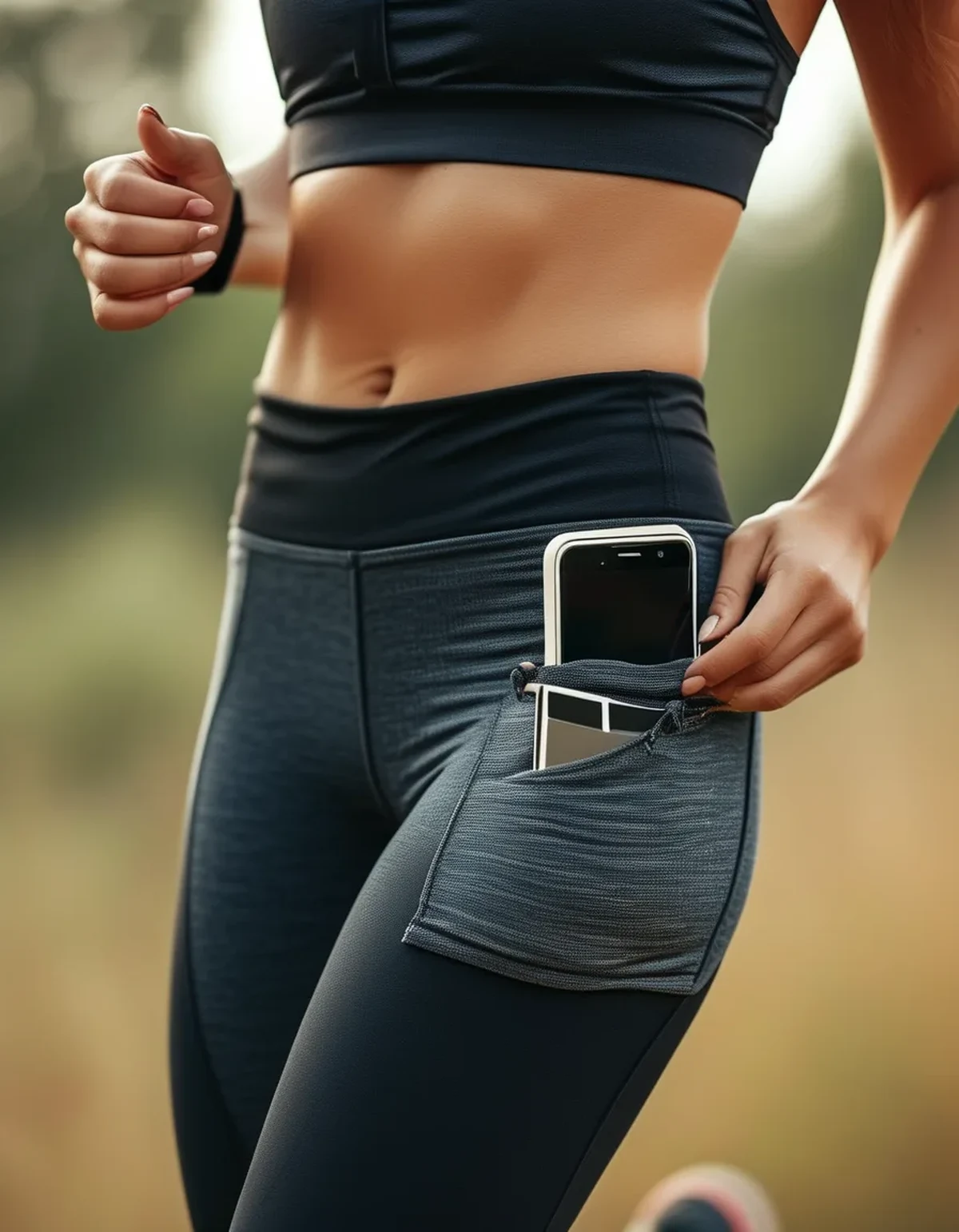
The outer thigh — the most common spot for a running-legging pocket — is also the point on your leg that travels through the largest range of motion during a running stride, swinging forward and back through a wider arc than almost anywhere else on the body during exercise. A pocket placed there isn’t just moving with your leg; it’s accelerating and decelerating with every single stride, and anything with mass inside it (a phone weighs 150-220 grams) has inertia that resists that rapid direction change, creating the bounce and slap you feel.
Pockets placed closer to the hip, on the waistband itself or just below it, move through a dramatically smaller arc during the same stride, because the hip rotates far less than the thigh swings. This is why waistband pockets and hip pockets, even on otherwise similar leggings, produce noticeably less bounce than mid-thigh placements — it’s not a fabric difference, it’s a physics-of-motion difference.
Pocket depth relative to placement compounds the issue. A shallow thigh pocket lets the phone’s weight sit further from the leg’s center line, giving it more leverage to swing outward with each stride. A deeper pocket, or one angled so the phone sits flatter against the leg rather than perpendicular to it, reduces that lever arm significantly — which is part of why some running-specific leggings angle the pocket opening diagonally rather than straight up-and-down.
What Role Does the Pocket Opening Actually Play?
This is the part almost no product description mentions, but it’s often the actual root cause of visible sagging (as opposed to bounce): most legging pockets are constructed from the same stretch fabric as the rest of the leg, with the pocket opening simply cut into that fabric and topstitched. Stretch fabric, by definition, gives under load — so the opening itself stretches wider every time the phone’s weight pulls against it during motion, and that stretch doesn’t fully recover between strides. Over the course of a run, the opening gradually loosens, which is why a pocket that felt snug at minute one is visibly sagging by minute twenty.
The fix construction-wise is a stabilizing interior seam or reinforced binding — a strip of lower-stretch fabric, sometimes fused with an interior lining, sewn around the pocket opening specifically to resist that repeated stretching. This is different from simply using thicker main fabric; it’s a targeted reinforcement at the one spot on the garment that takes repeated directional load. Leggings that mention “reinforced pocket” or “structured pocket opening” in the description are referencing this specific construction detail, and it’s worth looking for in close-up product photos — a reinforced opening usually has a visible contrast-stitched or bound edge rather than a raw stretch-fabric cutout.
Pocket-to-phone sizing is the third factor, and it’s counterintuitive: a pocket that’s noticeably larger than your phone doesn’t protect it better, it makes bounce worse, because the phone has room to shift and rattle inside the pocket with every stride instead of staying fixed against your leg. A close, snug fit — sometimes achieved with a small interior elastic band at the opening, distinct from the reinforced binding — keeps the phone from developing its own independent momentum inside the pocket.

5 Mistakes That Make Pocket Bounce Worse Than It Needs to Be
1. Buying based on pocket size alone. A bigger pocket looks more useful in a product photo, but oversized pockets let the phone shift and build momentum during a run, worsening bounce rather than preventing it.
2. Ignoring pocket placement relative to hip vs. thigh. If bounce-free running matters more to you than easy phone access, a waistband or low-back pocket will outperform a mid-thigh pocket on the same fabric every time.
3. Assuming all “reinforced” claims mean the same construction. Some listings use “reinforced” to describe thicker main fabric rather than a dedicated stabilizing seam at the pocket opening specifically — the two aren’t equivalent, and only the latter actually addresses opening-stretch over time.
4. Running with a phone case that adds significant bulk. Extra case weight and thickness increases both the inertia problem and the opening-stretch problem simultaneously — a slim case measurably reduces pocket bounce compared to a bulky one, all else equal.
5. Not checking pocket orientation in product photos. A diagonally-angled pocket opening (rather than a straight vertical slit) keeps the phone flatter against the leg with a shorter lever arm, and this detail is usually visible in a clear product photo if you look for it before buying.
What Nobody Tells You: The Fabric Around the Pocket Matters More Than the Pocket Itself
Most people evaluating running-legging pockets focus entirely on the pocket — its size, its zipper or no zipper, its placement — and overlook that the surrounding fabric’s stretch recovery is doing most of the actual work of keeping things secure. Stretch recovery is a fabric’s ability to snap back to its original shape after being stretched, and it degrades over the life of a garment through washing, heat exposure, and repeated wear, independent of anything happening at the pocket construction level.
This is why a pair of leggings can hold a phone securely for the first several months and then start sagging noticeably even though nothing about the pocket itself has changed — the fabric surrounding it has simply lost some of its elastane recovery through normal wear. Higher elastane content (generally 20%+ in the blend) and lower-heat washing/drying preserve stretch recovery longer, which indirectly extends how long a pocket stays functionally snug, even on a well-constructed reinforced pocket.
The practical implication: if pocket bounce develops gradually over months rather than being present from day one, the fix usually isn’t a different pocket design — it’s fabric fatigue, and it’s a signal the leggings’ overall stretch performance (not just the pocket) is aging out, often before other visible wear appears elsewhere on the garment.
FAQ: Legging Pocket Bounce Questions, Answered
Are zippered pockets actually better for running than open pockets?
A zipper prevents the phone from falling out but doesn’t address bounce, since bounce comes from placement and opening-stretch, not from the phone escaping. A reinforced opening matters more for bounce specifically than whether there’s a zipper.
Does a running belt solve this better than a legging pocket?
For serious mileage, yes — a belt keeps weight at the body’s center of mass rather than the swinging thigh. But a well-placed, reinforced hip or waistband legging pocket comes close for shorter runs without needing extra gear.
Why does my phone pocket feel fine walking but bounce badly running?
Walking produces a much smaller stride arc and less inertia than running, so placement and reinforcement issues that are invisible at a walk become obvious once stride speed and leg swing increase.
Can I fix a sagging pocket on leggings I already own?
A simple line of reinforcing stitching around the opening (hand or machine) can help somewhat, but it won’t fully replicate factory-reinforced binding, and it can’t restore fabric stretch recovery that’s already degraded elsewhere in the garment.
TL;DR:
- Outer-thigh pockets bounce more than hip or waistband pockets because the thigh swings through a much wider stride arc
- Most bounce and sag comes from the pocket opening stretching under repeated load, not from a design flaw in the phone-carrying idea itself
- A reinforced interior seam or binding at the pocket opening is the actual fix — not just thicker fabric or a bigger pocket
- Oversized pockets and worn-out stretch recovery both make bounce worse over time, independent of pocket placement
Next time you’re pocket-shopping, run your finger along the opening in the product photo — if you can’t see a distinct reinforced edge, assume it’ll stretch out, because it will.
See It in Motion
Seen here: Super High Waist Embossed Yoga Leggings with Inner Pocket — shop it on bubblelime.com
Keep Reading
This article is for general informational and styling purposes only. Fit, sizing, and product availability may vary.