Why Side Pockets and Waistband Pockets Fail in Completely Different Ways
Quick Answer: Side thigh pockets fail from movement - the phone swings on a long lever arm and the pocket fabric stretches sideways with every stride. Waistband pockets fail from pressure - the weight sits against your abdomen and the band has to be tight enough to hold it, which is what causes digging. Side pockets need a snug pocket opening and a high placement; waistband pockets need a wide band and a lightweight object. Neither design is better - they solve different problems.
Most people buy for pocket presence rather than pocket type, then blame the leggings.
The fix is usually matching the pocket to what you actually carry.

Why do side pockets let the phone slide and bounce?
Because of where they sit relative to the joint that is moving.
Your leg swings from the hip. Anything on the outside of your thigh travels along an arc, and the further down the thigh the pocket sits, the longer the lever and the more the phone moves. A pocket that ends mid-thigh moves a phone through several inches with every stride. A pocket that sits high, just below the hip bone, barely moves at all.
Then there is what the fabric does. Most side pockets are cut into a four-way stretch panel. Four-way stretch is what makes leggings comfortable and what makes pockets useless - the opening stretches as you move, and once it stretches, the phone starts to travel.
Weight compounds both problems. A phone in a heavy case can exceed half a pound, and the pocket is being asked to hold that against gravity, momentum, and a fabric that wants to give. Every step adds a small downward impulse, and the phone works its way lower over ten minutes.
The tell for a bad side pocket: it holds fine when you stand in the fitting room and starts sliding within five minutes of walking. The fitting room test is a static test of a dynamic problem, which is why it fails so reliably.
Why do waistband pockets dig in?
Because they are asking the band to do two jobs at once.
A waistband has to hold the leggings up. A waistband pocket asks it to also hold a phone against your body. The only way it can do that is with compression, and compression against a hard rectangular object concentrated in a small area is exactly what a dig feels like.
Band width is the single biggest variable. A narrow band spreads the load across less surface area, so the pressure per square inch goes up sharply. A wide band - roughly four inches or more - distributes the same weight across enough area that you stop noticing it.
Placement matters as much as width. A pocket at the center back sits against the lumbar curve, which is the most forgiving spot for a flat object. A pocket at the side of the waist sits over the softest tissue and moves the most when you bend, which is where marks come from.
And there is a hidden cost people miss: a loaded waistband pocket changes how the leggings sit. The weight pulls one section of the band down, which rotates the whole garment slightly and produces the sensation of leggings that will not stay put. You blame the fit; the cause is the cargo.
How do I match the pocket to what I carry?
Sort your items by weight and how often you need them, then pick accordingly.
Phone during a workout: high side pocket, snug opening. Look for a pocket that sits at or above mid-thigh, with a contrast binding or elastic at the opening rather than a raw stretch edge. The binding is the thing doing the work.
Phone during a walk or errands: waistband pocket with a wide band. You are not generating repeated impact, so the pressure issue is mild and the security is excellent. This is where waistband pockets genuinely win.
Keys, cards, and small items: waistband, always. Light, flat, and low consequence if they shift. Small hard items in a side pocket bounce against your thigh and are far more annoying than a phone.
Nothing heavier than a phone in either. A large phone in a rugged case sits at the edge of what any legging pocket handles well.
The two-minute test that actually predicts performance: load the pocket in the store, then do ten fast marching steps and two deep squats. If the phone moves during the squats, the opening is too loose. If the band rolls during the marching, the band is too narrow. This catches almost every failure before you buy.
What Nobody Tells You About Legging Pockets
Pocket depth is more important than pocket width. A deep pocket keeps the phone below the opening even when the fabric stretches. A shallow pocket relies entirely on the opening staying tight, which it will not.
A drop-in pocket sewn to the inner layer outperforms one cut into the outer fabric. The inner layer is under less strain during movement, so it stretches less and the pocket keeps its shape longer.
Pocket fabric wears out before the leggings do. The pocket is doing repeated stretch cycles under load in one small area. When your two-year-old leggings stop holding a phone, that is fabric fatigue, not your imagination.
Sweat travels. A phone in a side pocket against a damp thigh is sitting in the wettest microclimate of the garment. A waistband pocket at the center back stays noticeably drier than a side thigh pocket during hard work.
Compression fabric and pockets fight each other. High-compression leggings hold a phone brilliantly and are the most uncomfortable to bend in. Buttery-soft fabric is the opposite. You cannot have both, and knowing which you prefer saves a lot of returns.
And the one nobody expects: a phone in a side pocket changes your gait very slightly. Not enough to matter for a walk. Enough to notice on a long run, which is why runners overwhelmingly move the phone to an armband or a belt.
FAQ: Legging Pocket Questions, Answered
Are dual side pockets better than one?
Only if you carry two things. Otherwise a single loaded pocket creates a small asymmetry - noticeable on long runs, irrelevant for a walk. If you carry a phone and keys, splitting them across two pockets is genuinely better balanced.
Why do my pockets hold a phone fine one day and not the next?
Fabric relaxes as it warms and as it absorbs moisture. A pocket that holds well in a cool morning loosens once you are warm and damp. It is the same garment behaving differently, not a defect.
Should I size down to make pockets work?
No. Sizing down tightens the whole garment to fix one small area and usually creates waistband roll, which is a worse problem. Choose a different pocket design instead - it is the variable that actually controls the outcome.
TL;DR:
- Side pockets fail from movement; the lower the pocket, the longer the lever and the more the phone travels.
- Waistband pockets fail from pressure; band width is the main variable, and four inches or more solves most of it.
- Match the pocket to the load - phone plus impact goes in a high side pocket, everything light goes in the waistband.
- Test with squats and fast marching, not by standing still in a fitting room.
- Pocket fabric fatigues before the leggings do, so an old favorite losing its grip is normal wear.
Before your next purchase, do the ten-step and two-squat test in the store. It predicts almost everything.
See It in Motion
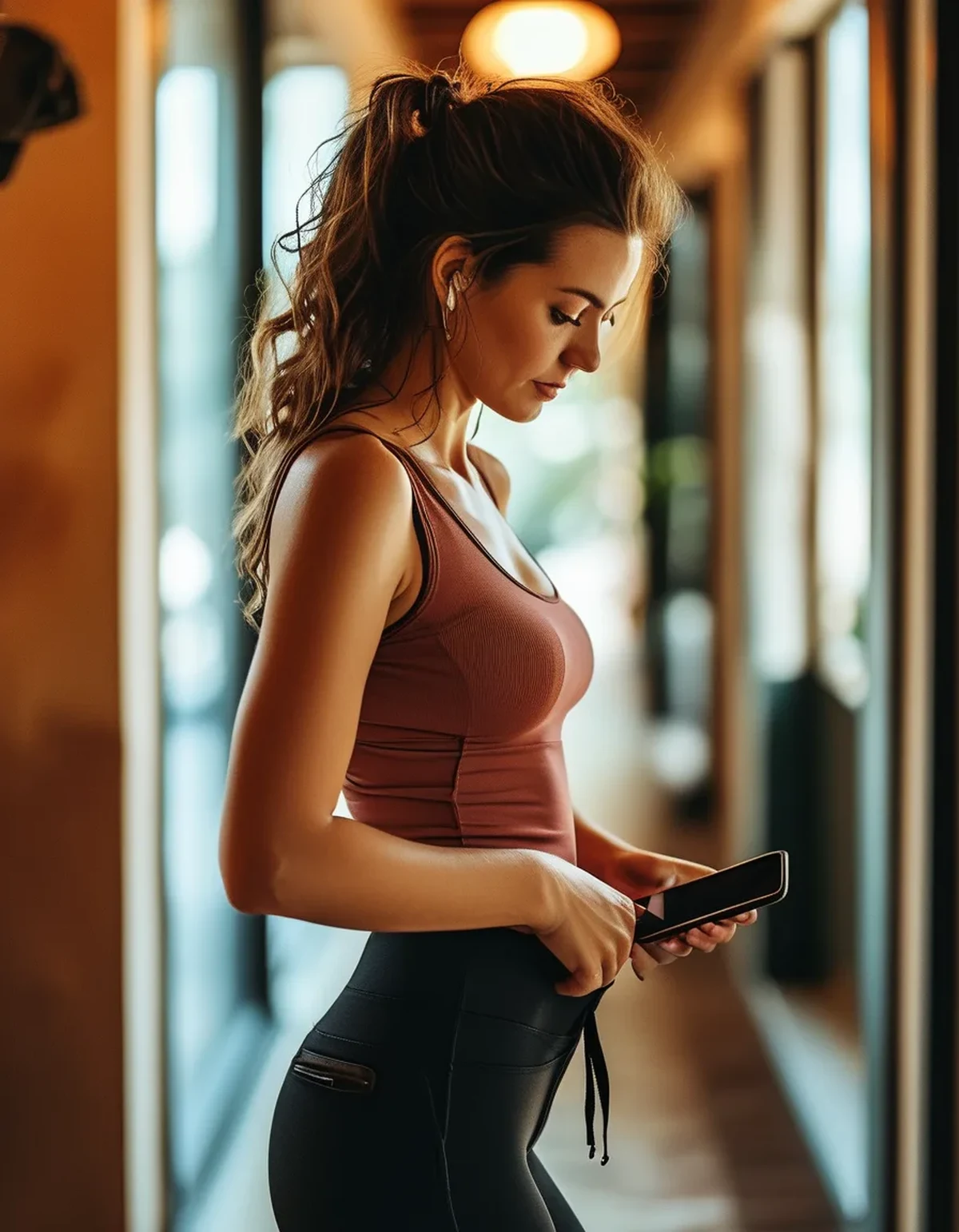
Seen here: High Waist Yoga Leggings with Side Pockets — shop it on bubblelime.com
Keep Reading
This article is for general informational and styling purposes only. Fit, sizing, and product availability may vary.