Why Your Legging Pocket Works on Walks and Fails on Runs
Quick Answer: A legging pocket that holds fine on a walk fails on a run because running adds vertical acceleration. A 200g phone effectively loads the pocket at two to three times its static weight at each footstrike, and that repeated force stretches the pocket opening and drags the waistband down. Walking produces almost none of it. The fix is pocket position — high on the outer thigh or in a compressive waistband — plus a doubled or bonded pocket layer, not a bigger pocket.
The pocket was perfect on the school run.
Eight minutes into an actual run, the phone is slapping your thigh and the waistband has started its slow descent.
Nothing about the pocket changed. The physics did.

Why does the same pocket fail as soon as you run?
Four things change at once, and they compound.
Vertical acceleration multiplies the load. A phone that weighs 200g standing still exerts 400 to 600g of peak force at each footstrike. The pocket is not holding a phone; it is catching one, repeatedly.
Footstrike frequency is relentless. At a typical running cadence you land roughly 160 to 180 times per minute. Over 30 minutes that is around 5,000 loading cycles on a seam that was tested by someone standing in a fitting room.
The load is off-centre. A single side pocket loads one hip. That asymmetry drags the waistband down on one side, which then rotates the whole garment.
Fabric stretch increases under repeated load. Knit fabric under cyclical stress relaxes progressively — the pocket opening that was snug at minute one is measurably looser at minute twenty.
Sweat makes it worse. Damp fabric has lower friction and greater elongation, so pockets loosen further exactly as the session goes on.
And walking has almost none of this. Walking produces roughly 1.1 to 1.2 times bodyweight at footstrike versus 2.5 to 3 times for running, and the phone barely moves relative to the leg.
Which pocket position actually survives running?
Position matters more than size, and the ranking is consistent.
High outer thigh, just below the hip bone. This is the least mobile part of the leg during running. Movement relative to the body is minimal, so the pocket has less work to do.
Compressive waistband pocket, at the back. The waistband is the strongest anchor in the garment and the back position is closest to your centre of mass. This is why running belts sit there.
Mid-thigh side pocket — the common one, and the worst. It sits where thigh circumference changes most through the stride, so the pocket is being stretched and released with every step.
Low leg or calf pockets. Fine for keys or a card. Never for a phone — the further from your centre of mass, the more the swinging weight disrupts your stride.
Front hip pockets. Comfortable standing, poor running. They sit right where hip flexion is greatest.
Depth beats width. A deep, narrow pocket that swallows the whole phone below the opening holds far better than a shallow wide one, regardless of position.

What to check before you buy running leggings with pockets
You can test almost all of this in a fitting room in about ninety seconds.
Put your own phone in and jog on the spot for 20 seconds. Not a bounce — an actual jog. Most pockets fail this immediately and the test costs nothing.
Check the pocket has its own fabric layer. A pocket cut into the main panel borrows structure from the leg; a bonded or doubled pocket carries its own load.
Feel the waistband width. A waistband under 6cm rarely holds a phone during running without sliding. Wide, high-rise waistbands with a silicone strip are the reliable ones.
Check the opening tension, not the pocket size. A pocket that takes the phone easily will release it just as easily.
Look for a horizontal opening on waistband pockets. Vertical openings on the waistband let contents ride up and out as you move.
Late-summer note: lighter warm-weather knits are more elastic and hold less well than the heavier autumn-weight fabrics arriving now. If a pocket has been marginal all summer, it may genuinely improve in a mid-weight legging.
5 Mistakes Everyone Makes With Legging Pockets
Buying for pocket size instead of pocket position. A huge mid-thigh pocket loses to a modest high-thigh one every time.
Testing while standing still. Every pocket works standing still. That test tells you nothing.
Loading one side only. Phone in one pocket and nothing in the other guarantees the waistband pulls down asymmetrically. Balance it with keys or a gel.
Sizing up for comfort. A looser legging has a looser pocket. Pocket performance is the one place where a slightly compressive fit genuinely wins.
Ignoring case thickness. A bulky case can add 40 percent to the phone’s cross-section, which is often the entire difference between a pocket that holds and one that does not.
And the one nobody mentions: washing on hot. Heat accelerates elastane degradation, and the pocket opening is the first place you notice it.
FAQ: Legging Pocket Questions, Answered
Can any legging pocket really hold a large phone while running?
A deep high-thigh pocket in a compressive mid-weight fabric can. Most standard side pockets cannot, regardless of marketing.
Do waistband pockets stretch the waistband permanently?
Repeated heavy loading does accelerate elastic fatigue. Using the waistband pocket for a phone daily will shorten the garment’s life.
Why does the phone bounce more when I get tired?
Stride mechanics degrade with fatigue, increasing vertical oscillation. The pocket did not change; your running did.
Is a running belt just better?
For phones during running, usually yes. It sits at your centre of mass and distributes load across the whole waist.
Do pockets weaken the legging?
A well-constructed bonded pocket does not. A pocket cut into a single-layer panel creates a stress point that often fails first.
How do I stop a stretched pocket getting worse?
Stop carrying a phone in it, wash cold, and air dry. Elastane recovery is real but partial, and heat prevents it.
TL;DR:
- Running adds vertical acceleration, loading a pocket at two to three times the phone’s static weight, thousands of times per session.
- Position beats size: high outer thigh and rear waistband hold; mid-thigh fails.
- Look for a bonded or doubled pocket layer and a waistband 6cm or wider.
- Test by jogging on the spot for 20 seconds with your own phone before buying.
- Balance the load across both sides and wash cold to protect the elastane.
Jog on the spot in the fitting room. It looks slightly ridiculous and it settles the question in twenty seconds.
See It in Motion
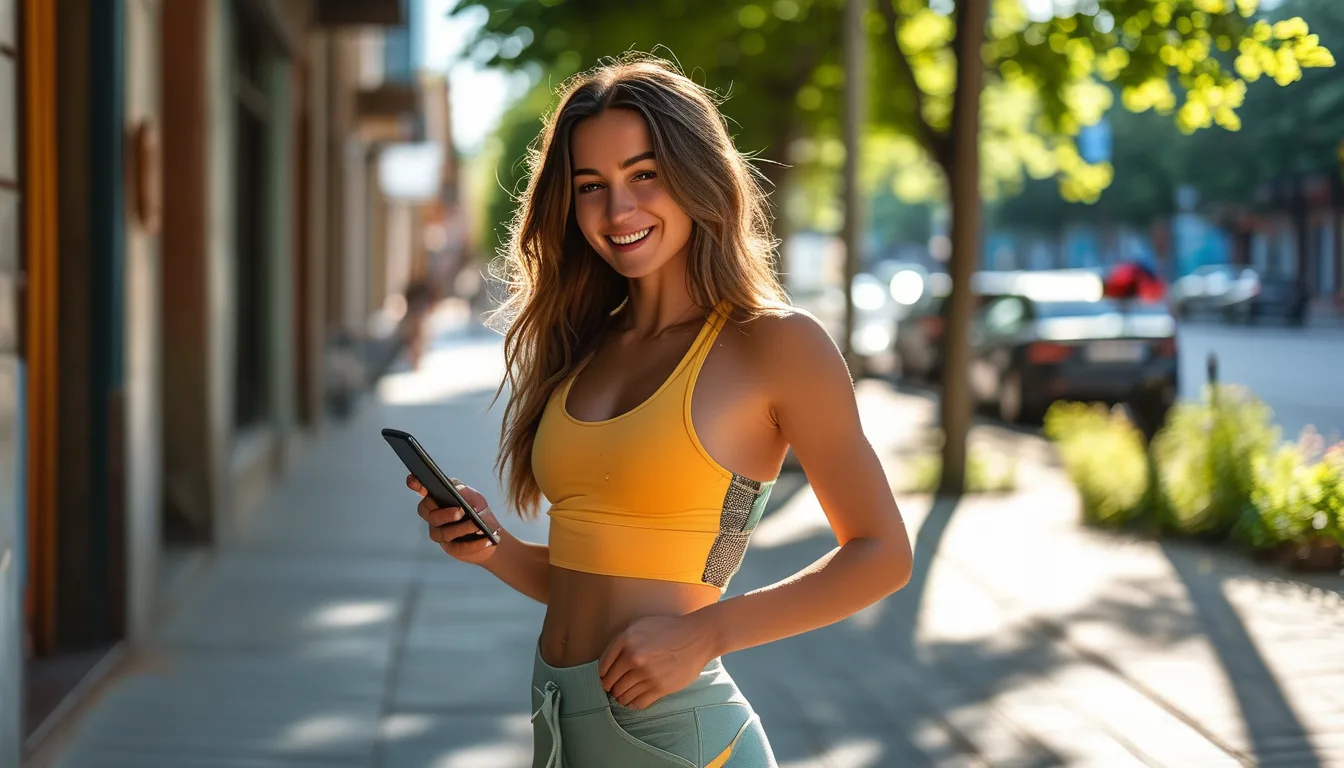
Seen here: Super High Waist Embossed Yoga Leggings with Inner Pocket — shop it on bubblelime.com
Keep Reading
This article is for general informational and styling purposes only. Fit, sizing, and product availability may vary.